
Your service AI can answer questions. Can it close the case?
The AI conversation in equipment manufacturing is stuck on the wrong question. Vendors demo what AI can say. The 300 leaders in the 2026 benchmark already judge by a different standard: what can it do.
What should AI actually do in equipment service?
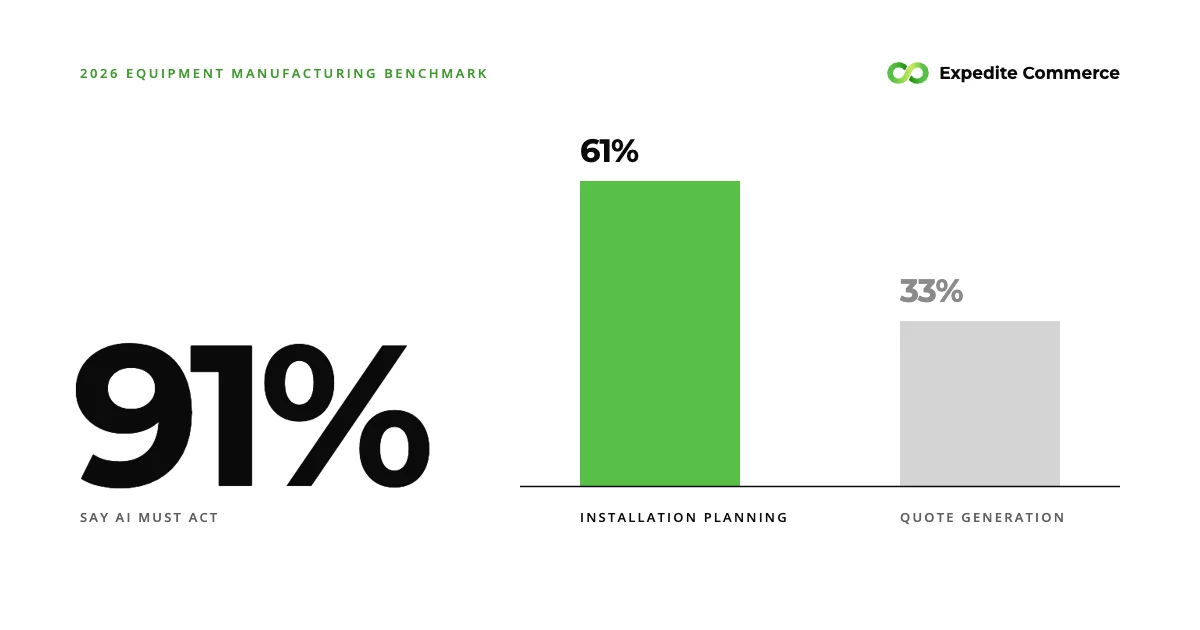
In the survey of 300 revenue and service leaders at U.S. equipment manufacturers (TrendCandy, 2026), 91 percent agreed that AI must be able to act - check a unit's coverage, find the part that fits, take the action - not just answer questions. Nine in ten of the people who buy service technology have already moved past the chatbot standard.
The logic is a customer with a down machine. They do not want a fluent summary of the warranty policy. They want the case closed: coverage confirmed, part identified, order placed, visit scheduled. An AI that stops at the answer stops exactly where the work begins.
What is the difference between AI that answers and AI that acts?
AI that answers reads documents and responds to questions - what does the warranty cover, what is the part number. Useful, and a real step up from searching. AI that acts - often called agentic AI - completes the task those answers belong to: it checks the specific unit's entitlements, matches the part to that unit's actual configuration, places the order, books the technician, updates the record. The difference is not intelligence. It is access to the systems and the data where the work lives. Answering requires documents. Acting requires the record of the unit.
Where do leaders want AI first? Not where the demos are.
The survey asked leaders to pick where AI would help most, and the two ends of the ranking tell the story:
| Where AI would help most (picked, not ranked) | Share |
|---|---|
| Installation planning - the top pick | 61% |
| Quote generation - near the bottom | 33% |
Installation planning - the least demoed, least glamorous stage - tops the list, while quote generation, the stage most AI marketing focuses on, sits near the bottom. Leaders want AI where the coordination pain is, not where the demos are easiest. The full ranking across all the operational areas is in the benchmark report.
The question that separates the two types
One question cuts through any AI evaluation in equipment service: can it check, find, and act - or can it only talk? The 91 percent finding says the market has already picked its standard. The gap between the two types is about to become visible in service metrics.
The full 2026 benchmark - the survey of 300 revenue and service leaders at U.S. equipment manufacturers.
Get the reportFAQ
What is agentic AI in field service?
Agentic AI in field service is AI that completes service tasks rather than only answering questions about them: it checks a specific unit's coverage, identifies the part that fits that unit's actual configuration, places the order, schedules the technician, and updates the record.
Why is a chatbot not enough for equipment service?
A chatbot answers questions; a service case needs resolution. A customer with a down machine needs coverage confirmed, the right part found, and a visit scheduled - work a question-answering system stops short of. In the 2026 survey, 91 percent of equipment manufacturing leaders agreed AI must be able to act, not just answer.
Where should equipment manufacturers use AI first in service?
Their own leaders point at installation planning: 61 percent picked it as where AI would help most, against 33 percent for quote generation. Coordination-heavy stages ranked above the stages AI vendors demo most.
What data does AI need to act in equipment service?
The record of the unit: its as-built configuration, entitlements and coverage, service history, and the commercial terms around it. AI that answers needs documents; AI that acts needs that record - which is why the data foundation decides what the AI can do.