
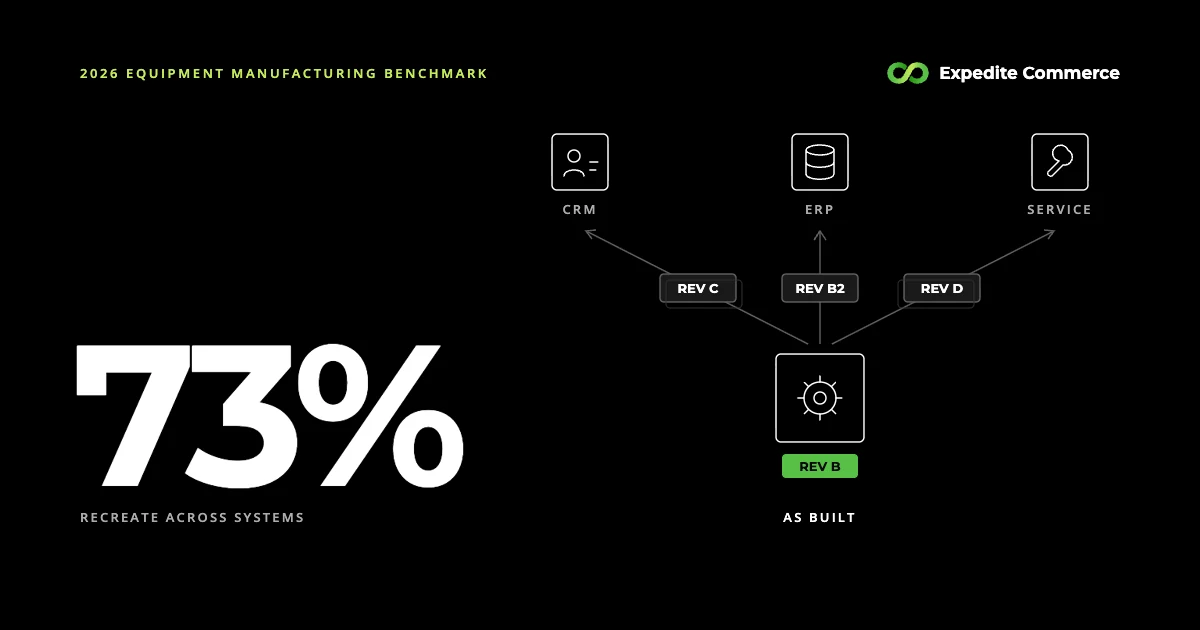
Sold, built, serviced: three records of the same machine, and none of them match
The quietest findings in the 2026 benchmark are the most structural. They describe a problem with no dramatic moment - just a record that breaks at the sale and stays broken for the life of the machine.
Why does configuration data cause problems years after the sale?
In the survey of 300 revenue and service leaders at U.S. equipment manufacturers (TrendCandy, 2026), 65 percent said configuration data creates downstream issues, and 73 percent said business rules - pricing, configuration, service logic - are recreated across systems at least frequently. A machine is quoted in one system, built per another, and serviced from a third, with people re-entering the connective information at every border.
The costs surface far from the cause. A configuration error made at quoting becomes a service escalation two years later, when a technician arrives with a part that fits the ordered machine but not the built one. A rule changed by the business becomes three re-implementations - and drifts a little each time.
What is an as-built record, and where does it break?
The as-built record is the description of what was actually manufactured and installed for a specific unit - its real configuration, options, serials, and modifications - as opposed to what was ordered. It breaks at the first handoff: the sale closes, the order becomes a build, field adjustments happen at installation, and the resulting truth about the unit stays in the installation team's files. From then on, sales history says one thing, the field says another, and service navigates between them.
What does starting from zero cost every day?
Two numbers in the study measure the daily tax. 71 percent of leaders said customer conversations begin with information the company should already know - at least frequently. The customer repeats what they own, what it does, and what was agreed, to a company that sold them all of it. And 42 percent said employees spend significant time searching for information instead of solving the problem in front of them. That is not a technology gap. It is the absence of one shared record of the unit.
What do companies with one record do differently?
Nothing heroic. They are not more careful, and their people are not better. They simply stopped copying: what was sold becomes what is built, what is built becomes what is serviced, and a rule changed once is changed everywhere. Every downstream symptom in this post - the wrong part, the recreated rules, the conversations from zero, the search time - is the same record, broken in a different place.
The full 2026 benchmark - the survey of 300 revenue and service leaders at U.S. equipment manufacturers.
Get the reportFAQ
What is as-built configuration data?
As-built configuration data describes what was actually manufactured and installed for a specific unit - its real configuration, options, serial numbers, and field modifications - as opposed to what was ordered. Service, parts, and coverage decisions all depend on it being accurate and reachable.
Why do service teams work from the wrong equipment data?
Because the record breaks at the handoffs: the order is captured at the sale, adjustments happen during build and installation, and the resulting truth about the unit never travels into the service system. Service then works from what was sold rather than what was built.
How often do manufacturers recreate business rules across systems?
In the 2026 survey of 300 U.S. equipment manufacturers, 73 percent of leaders said rules for pricing, configuration, and service logic are recreated across systems at least frequently - each recreation an opportunity for drift and error.
What does a missing equipment record cost day to day?
Two measures from the same survey: 71 percent of leaders say customer conversations begin with information the company should already know, and 42 percent say employees spend significant time searching for information instead of solving the problem in front of them.